The Five Pillars of Islam: Foundation of Muslim Faith

Shahada (faith statement), Salah (daily prayer), Zakat (charity), Sawm (fasting during Ramadan), and Hajj (pilgrimage to Mecca) are the Five Pillars of Islam, which are the fundamental required activities that constitute the basis of Muslim life. Believers are united in a framework of dedication, self-control, and social duty by these rituals.
The Five Pillars of Islam
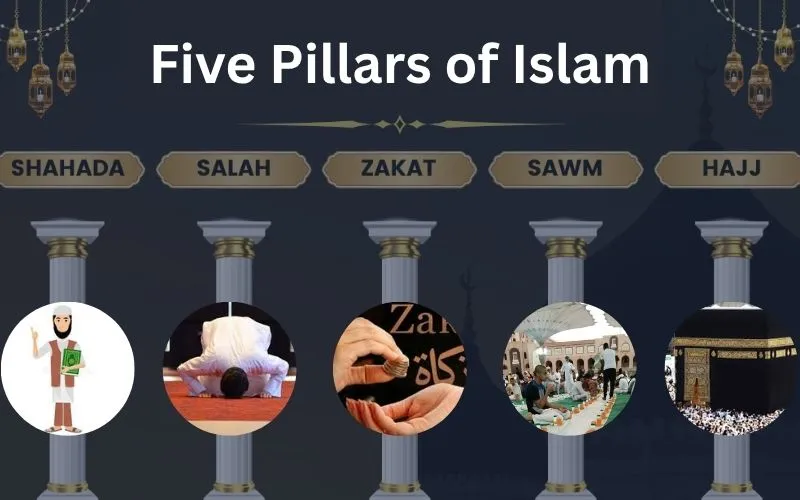
All Muslims are required to adhere to five essential practices throughout the duration of their lives. Because they serve as the cornerstone of Muslim life, these customs are known as pillars. Shahada, Salah, Zakat, Sawm, and Hajj are the five pillars of Islam.
The fundamental tenets and customs of Islam are known as the Five Pillars of Islam:
Declaration of Faith (shahada)
The core belief of Islam is that "there is no god but God, and Muhammad is the Messenger of God." The Qur'an, Islam's sacred book of heavenly revelations, is one of several items that frequently display this Arabic phrase prominently. Reciting this statement with passion makes one a Muslim.
Salat, or prayer
At dawn, noon, mid-afternoon, sunset, and after dark, Muslims face Mecca during their five daily prayers.
The first chapter (surah) of the Qur'an is recited during prayer, which is occasionally done on a tiny rug or mat designated for this purpose. Muslims can worship collectively in a mosque under the direction of an imam, or individually at any place.
Women are invited but not obliged to attend the Friday midday prayer, which is held at the mosque. Following the prayer, the imam offers prayers and discusses a specific Islamic subject before a sermon that centers on a chapter from the Qur'an.
Zakat, or alms
Zakat is the third of Islam's five tenets. Muslims are required by Islamic law to give a certain percentage of their earnings to underprivileged members of society.
Mosques, water fountains, hospitals, schools, and other establishments are constructed by many monarchs and affluent Muslims as a religious obligation and to obtain the benefits of generosity.
Fasting (sawm)
All healthy adult Muslims must refrain from eating and drinking during the daytime hours of Ramadan, the ninth month of the Islamic calendar.
They become more conscious of and appreciative of all that God has given them in life, especially the Qur'an, which was initially revealed during this month, as a result of this brief deprivation.
As a reminder of their religious obligation to assist those in need, they share the hunger and thirst of the poor throughout Ramadan.
The Final of The Five Pillars of Islam: Hajj pilgrimage
The holy city of Mecca, located in modern-day Saudi Arabia, must be visited at least once by every Muslim whose health and financial situation allow it.
The focal point of the Haram Mosque in Mecca is the Ka'ba, a cubical building covered in black embroidered hangings. Muslims face the qibla, or direction of the home Abraham (Ibrahim in Arabic) constructed for God, when they pray.
On the eighth and twelfth days of the last month of the Islamic calendar, Muslims from all over the globe have congregated around the Ka'ba in Mecca since the time of the Prophet Muhammad.
What makes the five pillars of Islam significant?
Every Muslim's lifestyle is infused with the spirit of Islam, which is a religion of peace and obedience to Allah SWT, via the cooperation of the five pillars:
The core of Islam is monotheism and the conviction that the Prophet Muhammad (peace be upon him) is God's final messenger. Muslims are reminded of this fundamental belief by repeating the Shahada (shahadah) in prayer every day.
Salah, also known as salat, takes place five times a day and provides five distinct chances to remember Allah SWT and the reason we are here to worship Him.
Every Muslim must refrain from their most fundamental wants and desires, including food, drink, and sexual interactions, for a certain amount of time every day throughout the month of Ramadan.
Muslims have the chance to take charge of their human needs each year during the Sawm. Muslims can instead cultivate their behavior and their relationship with Allah SWT in the absence of these distractions.
Zakat (alms) must be given once a year to ensure that money is continually redistributed to those in need, even if sadaqah (charity) is strongly urged to be a part of daily Muslim life.
Muslims are required to conduct the same ritualistic acts of devotion to Allah and wear the same basic clothing throughout the Hajj (pilgrimage). People are reminded that everyone is equal before God when they are stripped of their worldly distinctions.
The Five Pillars' Effect on the World
A moral, social, and spiritual framework that fortifies Muslim society worldwide is woven together by the five pillars of Islam. They instruct believers to uphold the principles of justice, compassion, humility, and solidarity that foster social harmony and international concord.
Every action in the five columns adds to a world where Muslims love one another and live with purpose, from daily prayers that provide discipline to charitable endeavors that aid the underprivileged.
These articles serve as a reminder to all believers that they belong to a united, interconnected Ummah that transcends cultural and geographic barriers.
Conclusion Related to the Five Pillars of Islam
In addition to being acts of devotion, the five pillars of Islam serve as a source of harmony and moral fortitude. They strengthen communities through love, respect, and service while providing spiritual nourishment to individuals.
The five columns serve as timeless ideals of solidarity that guide Muslims toward a common destiny based on faith, compassion, and peace in a world where divisions are common. Through them, Muslim society is linked to an ambiguous global network of religion and fraternity that is still growing today.
Learn about the Five Pillars of Islam's beauty and wisdom and how they influence a Muslim's everyday life and beliefs.
Through organized, interesting online courses, we at Alhamd Academy assist students of all ages in comprehending Islam and developing a relationship with the Quran. Enroll in our academy now to expand your knowledge, get better at reciting the Quran, and develop spiritually.